Zero-Shot Learning
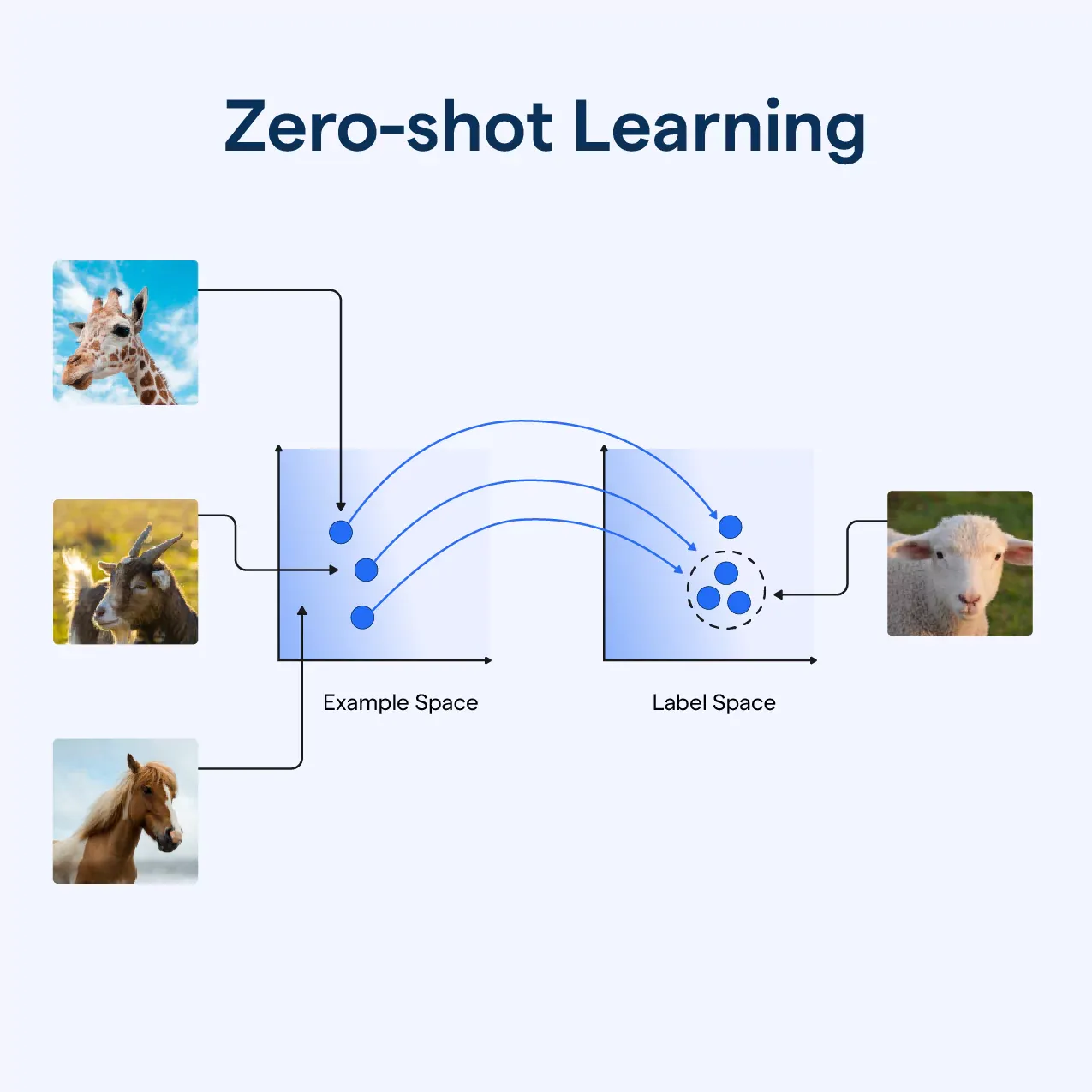
Photo by www.botpenguin.com
One of the most impressive features of modern artificial intelligence is its ability to carry out tasks for which it has not been specifically trained. In the past, machine learning models needed labeled examples to deal with each particular task. For instance, if you wanted an AI to be able to recognize cats, you had to give it images of cats. If you wanted it to detect spam emails, you would train it using examples of both spam and genuine messages. But what occurs when a model has to identify something that it has never come across during its task-specific training? This is precisely where zero-shot learning becomes so interesting.
Zero-shot learning is a machine learning method that allows models to identify new categories or carry out tasks they are not familiar with without the need for labeled training examples for those particular tasks; rather than learning directly from examples of the category in question, the model makes use of the knowledge it has gained earlier during training and applies the relationships between concepts to reach its predictions.
Suppose an AI system is trained to recognize different animals but is never given any images marked as zebras. Even if the system knows the visual features of horses and has the concept of black-and-white stripes, it could still manage to identify a zebra from a written description. It does not need zebras’ labeled images when it is being trained for this specific task since it can apply its current knowledge to the new category.
Such abilities are made possible by means like semantic representations, transfer learning, and shared embedding spaces. By learning the relationships between different kinds of information, the models can link familiar concepts with those that are unfamiliar. For instance, multimodal models can connect textual descriptions with visual features. Thus, it is possible to classify images using category names or descriptions that were not explicitly included as labeled classes during training.
Zero-shot learning has become particularly important as a result of the development of large language models. If you ask an AI assistant to summarise an article, categorize customer feedback, or translate a sentence without first giving it any examples of the desired output, then you are employing a type of zero-shot prompting. The model tries to carry out the task entirely based on the knowledge it has been pre-trained on and the instructions you give it.
However, although zero-shot learning and zero-shot prompting are closely related, they are not the same. Traditional zero-shot learning usually involves deriving generalizations for unseen categories by means of learned semantic relationships. Zero-shot prompting means giving a pretrained model a task to carry out without including any demonstrations in the prompt. It is important to note that a model carrying out a task in a zero-shot setting might still have come across similar information or tasks earlier during its original training.
It also clarifies the connection between zero-shot and few-shot learning. Although both methods seek to decrease the need for large datasets that are specific to a task, they differ in the amount of guidance that is given. In the case of few-shot learning, a small number of examples are provided to assist the model in adapting or in understanding the required pattern; zero-shot learning, on the other hand, gives no labeled examples for the particular task and therefore requires the model to place greater reliance on the knowledge it has acquired previously.
Even though it has some advantages, zero-shot learning does not ensure reliable performance, since the models may have difficulty when the tasks in question require specialized knowledge of a particular domain, accurate reasoning, or concepts that were not well represented during the pretraining phase. Moreover, the performance will also depend on how clearly the tasks are described and on how well the model can apply its existing knowledge to new situations.
The importance of zero-shot learning extends beyond reducing the need for labeled datasets; it means moving toward AI systems that can apply their knowledge more flexibly rather than learning each task separately. In a world in which new problems continually arise, it is neither practical nor possible to collect specific training data for every possible situation.
In the end, zero-shot learning challenges the conventional idea that an AI system must be given examples of a particular task to try to solve it. The capacity to apply knowledge to new kinds of problems represents a significant advancement towards achieving more general-purpose intelligence. Even though today’s models still have some important limitations, the fact that they possess zero-shot capabilities shows that the value of learning lies not simply in remembering what has already been seen, but in using existing knowledge to grasp what comes next.