Augmented Reality (AR) vs. Virtual Reality (VR)
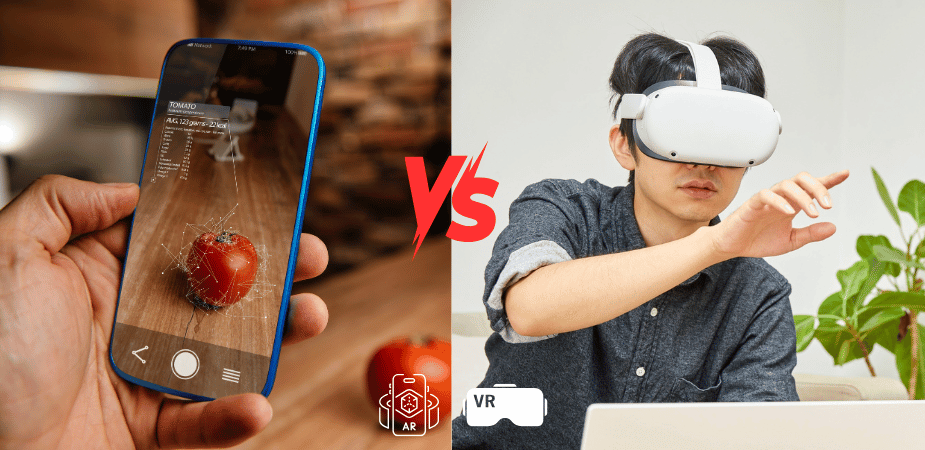
Photo by vofoxsolutions.com
Augmented Reality (AR) and Virtual Reality (VR) are frequently regarded as interchangeable technologies; however, they address fundamentally different challenges. The primary distinction lies in whether the technology replaces the user’s environment or enhances it. If the technology replaces the environment, it is classified as Virtual Reality. If it enhances the environment, it is considered Augmented Reality. Recognising this difference is increasingly important as immersive technologies expand beyond gaming into sectors such as education, healthcare, manufacturing, retail, and enterprise collaboration.
Augmented Reality (AR) enriches the physical world by overlaying digital content onto real surroundings. Rather than isolating users from reality, AR provides an additional layer of information. For example, a smartphone can display how a new sofa would fit within a living room before purchase. Surgeons may use AR glasses to visualise patient anatomy during operations, and field technicians can receive step-by-step repair instructions superimposed on the equipment being serviced. In all cases, the real world remains visible while digital information enhances utility, interactivity, and intelligence.
Virtual Reality (VR) employs a fundamentally different approach. Instead of augmenting reality, VR creates an entirely new environment. When a user dons a VR headset, physical surroundings are replaced by a fully immersive digital environment. Users may experience walking through ancient Rome, training within a virtual aircraft cockpit, exploring the surface of Mars, or collaborating with colleagues in a digital workspace that does not physically exist. VR is designed to maximise immersion by fostering a sense of presence within a computer-generated world where all objects, sounds, and interactions are simulated.
An analogy can clarify this distinction. In a kitchen setting, AR could display digital recipe instructions on the countertop and ingredient labels above the food being prepared, allowing the user to remain in the physical kitchen while benefiting from digital information. In contrast, VR would remove the physical kitchen entirely, transporting the user into a professional virtual cooking school where all appliances, ingredients, and instructors exist solely in the digital environment. Thus, AR adds intelligence to reality, whereas VR temporarily replaces reality with an immersive simulation.
Neither technology is inherently superior, as each addresses distinct requirements. AR is most effective when users must remain aware of their physical environment while accessing contextual digital information, making it suitable for navigation, maintenance, healthcare, retail, and industrial applications. Conversely, VR is optimal when complete immersion is necessary, such as in training, education, simulation, entertainment, design reviews, or remote collaboration. As spatial computing evolves, a clear understanding of the boundaries between AR and VR will enable businesses, developers, and creators to design experiences that address real-world challenges rather than merely adopting the latest technological trends.

Photo by pinterest.com